
Armatir Systems
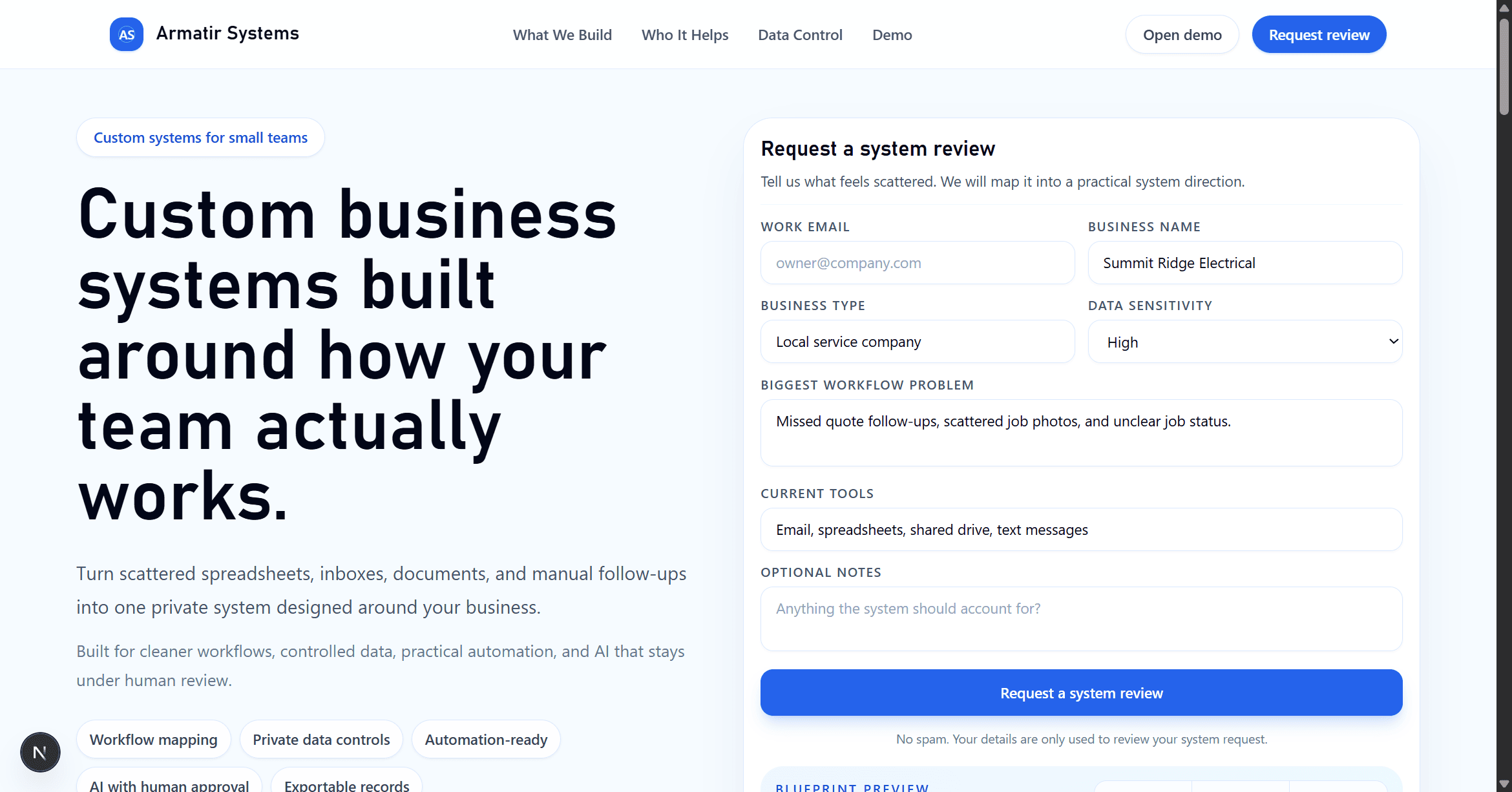
Armatir Systems is a backend-heavy product demonstration for custom internal business systems. It shows how a small business workflow can become a private command platform with structured intake, database-backed lead records, admin review, browser-persisted workspace actions, automation planning, and safer AI-assisted summaries.
Demo coming soon
The project is complete, but the public live demo is being held until the deployment path is ready. The case study documents the implemented architecture, data modes, and demo workspace behavior.
Many small teams run important work through spreadsheets, inboxes, shared drives, text threads, and disconnected tools. That setup can work early on, but it becomes fragile as the business grows: follow-ups get missed, context is scattered, sensitive details are copied into generic AI tools, and there is no reliable record of who reviewed what or what happened next.
Armatir Systems demonstrates a custom command platform built around the business workflow instead of forcing the workflow into a generic product. A submitted request becomes a structured lead record, the backend generates a System Blueprint and lead score, the workspace supports review/status changes and notes, and the architecture leaves room for durable persistence, audit logs, email automation, data controls, and practical AI assistance.
Technical foundation
This project is intentionally heavier on backend behavior than a standard portfolio demo. The value is in the route handling, validation, database model, repository abstraction, lead lifecycle, email flow, audit events, and controlled AI layer behind the interface.
- Frontend
- Next.js App Router, React 19, TypeScript, and Tailwind CSS.
- Backend
- Route handlers for public intake plus lead detail, status, and note updates.
- Data layer
- LeadRepository abstraction with mock memory mode, local SQLite/Prisma mode, and a hosted database mode prepared for durable persistence.
- Validation
- Zod schemas validate intake and lead update payloads before business logic runs.
- AI
- Optional OpenAI lead summaries with deterministic summary fallback when no API key is configured.
- Resend-compatible admin notifications and prospect auto-replies, with stubbed logging when credentials are absent.
- Control layer
- Audit logs, data-control toggles, redaction/exposure previews, approval gates, and document sensitivity states.
- Deployment
- Vercel-safe mock mode by default; DATA_MODE and DATABASE_URL switch the backend toward local or database-backed behavior.
Backend workflow
A visitor submits a structured system-review request through the intake form.
The intake route parses JSON, validates required workflow fields, and returns field-level errors for invalid submissions.
The repository generates a System Blueprint, calculates an explainable lead score, and creates the lead record in the active data mode.
Prisma-backed modes persist lead fields, AI summary text, serialized blueprint data, notes, status, and audit metadata.
The lead detail API supports status changes and internal notes, with status validation and audit events for important mutations.
Email helpers notify Armatir and send a prospect auto-reply when Resend credentials exist; otherwise the flow completes through logged stubs.
The demo workspace stores visitor interactions in browser localStorage and exposes a reset path for repeatable review sessions.
AI and data-control posture
AI is treated as a workflow assistant, not the product itself. The system is built around structured business inputs, generated summaries, recommended modules, internal review, redaction choices, and auditability.
System Blueprint generation turns intake answers into suggested modules, automations, AI uses, and data controls.
Lead summaries can use OpenAI when configured, but deterministic fallback keeps the workflow usable without third-party services.
AI review actions stay behind human approval states in the demo workspace.
Data-control screens show which fields are included, redacted, exposed, blocked, or approval-gated before an AI-assisted action.
Document sensitivity and AI-access toggles make operational data handling visible instead of hidden inside an automation.
Business use cases
An electrical contractor can turn quote requests, site notes, permit follow-ups, and job status into one reviewed workflow.
A plumbing or HVAC company can route service requests, follow-ups, documents, and owner reviews without losing context in email.
A renovation or repair business can track leads, jobs, documents, and required next actions in one operational view.
A consultant, local agency, or small operations team can adapt the same pattern around their intake, review, and reporting needs.
Sensitive workflow details can be handled with more control than copy-pasting customer data into a generic AI chat.
Client relevance
For clients, the project shows the difference between a polished website and a real operating layer behind the business. It demonstrates that Armatir can design the customer-facing experience, backend workflow, database model, admin workspace, automation layer, and AI/data-control strategy together.
Full-stack App Router project with a public marketing/intake surface and private-style demo workspace routes
Zod-validated intake API with explainable lead scoring and deterministic System Blueprint generation
Repository pattern spanning mock server memory, local SQLite/Prisma, and a hosted database mode prepared for durable persistence
Lead status updates, internal notes, and audit events through shared repository methods
Browser-persisted demo workspace covering leads, jobs, clients, tasks, documents, automations, AI review, data controls, reports, and settings
Optional OpenAI lead summaries and Resend-compatible notifications/auto-replies with deterministic or stubbed fallbacks
Data-control model covering redaction toggles, AI access rules, approval gates, document sensitivity, and exposure previews
Report/export demo behavior that logs activity back into the workspace timeline
Shows how Armatir can design the customer-facing intake, backend workflow, data model, admin workspace, automation layer, and AI/data-control strategy as one cohesive internal system.
- Status
- Završeno
- Godina
- 2026
- Uloga
- Product strategy, full-stack architecture, backend implementation, UI design, data modeling, and demo workspace build